Showing posts with label review. Show all posts

Friday, 4 October 2013

THEATRE REVIEW: Matilda the Musical

Cambridge Theatre, London

21 September 2013

now booking until December 2014

Matilda the Musical at the Cambridge Theatre
Photo: Laura Peatman

Matilda the Musical is one of the most talked-about musicals of the last few years, finding unprecedented success at the 2012 Oliviers with seven awards (since equalled by The Curious Incident of the Dog in the Night-Time, one of my other all-time favourite shows). With the genius of Tim Minchin, enthusiasm of a young cast, mad costumes and brilliant staging, this is one of those shows where everything comes together to create magic. Forget the film, this is how the story of Matilda should be told.

Even the opening set that greets the audience on arrival establishes a sense of fun, with countless colourful wooden blocks that sprawl across the back wall and out of the proscenium arch, seemingly random but actually delightfully concealing words if you look carefully enough. This level of detail is present throughout, making it feel that real love and warmth has gone into this production. Everything from Mr Wormwood's suit, to the children's messy hairstyles, to the wide array of CCTV in Trunchbull's office has been carefully thought out and contributes to a show that just works, in the best way possible. 'School Song', with the alphabet hidden within the lyrics, is brilliantly staged, as letter blocks appear in the school gates just a split second before a chorus member steps onto it: it must have taken hours of rehearsal but appears effortless, as all great routines should.

There's a risk that a young cast, however talented, can appear precocious and start to grate a little: no fear of that here, as all the children are fantastic and complete naturals on stage. I can't think of many things more fun than being a kid in this show, and to be quite honest I'm immensely jealous of them all. Their singing, acting, and probably above all their dancing, put a huge smile on my face from start to finish – and when they rock out to 'Revolting Children', it confirms that they really are the stars here. At this particular performance, George King as Bruce Bogtrotter stole the show with his hilarious acting and rockstar-worthy opening to 'Revolting Children', while tiny Freddie Haggerty stole our hearts as Eric. Georgia Pemberton, in her first month as Matilda, took on the leading lady duties and is evidently proving herself a great addition to the cast. She is funny, heart-warming and mischievous, and at times heart-rending. And her Russian is impeccable, of course... (I'm not going to explain that one – no spoilers!). The role of Matilda has a lot of time alone on stage, and to pull this off at such a young age is undoubtedly impressive – and I'm sure the memories of receiving the applause in her solo curtain call will stay with all the Matildas for a long time, whatever their future career path.

Photo: Ben Tavener
Elsewhere the Wormwoods (James Clyde and Kay Murray) and Rudolpho (Joshua Lay, utterly unrecognisable from his headshot in the programme!) provide plenty of hilarity, while Alex Gaumond is fabulously horrible, and more than a little creepy, as the notorious Miss Trunchbull. The cast have great fun with the height difference between him and the children, and every movement and flinch is perfectly timed to create this funny but disturbing baddie.

There is some pretty puerile humour here – Bruce's prolonged description of his chocolatey belch springs to mind – but the show somehow still doesn't feel childish. About children yes; great for children to watch, also yes; but despite all this there's emotion in it that certainly appeals to adults as well. The shadow puppetry of the acrobat and the escapologist is simply beautiful, while the poignant scenes between Matilda and her parents really do tug at the heartstrings. Overarching the whole production is a great sense of being a child, being 'Naughty', and being free from rules and expectations, summed up in the gorgeous 'When I Grow Up', with its use of slides, swings and scooters. Matilda is surely the best new musical of recent years, and one that I could watch again and again and carry on smiling at. Fingers crossed it will stay in the West End for many more years to come!

Wednesday, 2 October 2013

THEATRE REVIEW: Our House

New Wolsey Theatre, Ipswich

12 September - 5 October, then touring the UK until 23 November

Our House is by no means a household name when it comes to musicals, rather unfairly it seems. The show first hit the West End in 2002 to mixed reviews, but bagged the 2003 Oliver Award for Best Musical, and went on a national tour from 2008-9. Critic Mark Shenton has called it the best jukebox musical since Mamma Mia! as well as the most underrated – and now a new national tour by the New Wolsey Theatre Company is aiming to change that. Judging by the reaction of the audience, the show already has a lot of fans in the home of the company, Ipswich.

Tim Firth's show is based around the songs of ska kings Madness, and follows 16-year-old Joe through two alternative paths through his life, depending on a decision at the beginning of the story. This does make some early scenes a little confusing, as the action shifts rapidly between alternate realities of the plot (marked helpfully by Joe's two different outfits), but it gets into its stride after a while. The relatively small stage has the potential to create difficulties with the complex set – it's a bit different from the show's original home at the Cambridge Theatre, London – but the cast and creative team make the most of the space they have, and in actual fact the concentration of the cast's energy works in the production's favour.

The ensemble musical numbers are definitely the best element of the show. The cast have bags of energy, throwing themselves into the routines with boundless enthusiasm and a huge sense of fun, so songs such as 'Our House', 'Baggy Trousers' and 'Wings of a Dove' have you itching to get up there and join them. There were a few problems with sound balance meaning the lyrics sometimes got lost – although it's hard to tell if this was true for the whole audience, or just for those of us in the balcony – but this didn't harm the overall effect too much. The decisions to cast actor-musicians makes the music blend effortlessly into the show, as backing track and performers become one, really boosting the party atmosphere.

There are more touching scenes too, and Alexis Gerrerd as Joe manages to balance his cocky swagger with vulnerable moments, particularly in his obvious hurt pride and feelings of inferiority at seeing the better life Sarah (Danielle Bowen) has made for herself after leaving him behind. Switching quickly between the two possible lives of his character, not only does he manage the difference in personality with ease, but he has some lightning-quick costume changes that are deservedly greeted with applause. The two double acts of Emmo and Lewis (James Haggie and Alex Spinney) and Billie and Angie (Natasha Lewis and Dominique Planter), Joe and Sarah's loyal friends, provide plenty of comedy – particularly the girls, who are alternately over-excited by Sarah's life or distinctly underwhelmed by Joe's efforts.

The plot is a little flimsy at times: despite the justification within the script, it's hard to believe a 16-year-old would be sent to prison in those circumstances, for example. The Blood Brothers-esque presence of Joe's father is risky but avoids cliché through a strong performance by Sean Needham, who shies away from over-exaggerated mysticality. Parts of the show are a little cheesy, it's true, but these weaknesses are forgotten in the face of the raucous and joyous musical numbers that can't help but put you in a good mood. It's not the most intellectually stimulating of shows – but then who really looks for that in a musical? Showcasing a brilliant cast, Our House is a whole heap of fun and laughter that's certainly good for the soul.

Friday, 9 August 2013

EDINBURGH FRINGE 2013: REVIEW: All or Nothing?

Callàs Company

Greenside Venue

5 Aug 2013

runs until 24 Aug 2013

Going along to this show encompasses what I love about the Fringe. A random conversation with a theatregoer at C venues led to my and friend and I making a mad dash to see his show at Greenside on our lunch break, with very little idea of what it would be like. As it turns out, this is one of my favourite shows of the Fringe so far — funny, charming, lacking in pretension and altogether wonderful.

The concept works beautifully: two characters live in a silent world, one in the realm of imagination and mime, and the other in the realm of physical reality. They meet, become friends, fall in love. It sounds a bit too simple to engage your attention, but the characters' discovery of each other's worlds is imaginative and witty, as mutual bafflement raises many a laugh. James Callàs Ball and Jasmine Blackborow's mime is a joy to watch as the invisible, imaginary world is effortlessly brought to life through their performance, bringing humour to this light-hearted production without becoming over-exaggerated. It is, strangely, an utterly believable show despite its surreal plot.

Being only forty minutes, the show is a neat little production but should not be overlooked in the Fringe's saturated programme, being well-constructed and faultlessly performed by a talented cast of two, in a new company making its début at the Fringe. The jazz soundtrack is reminiscent of the silent movies of the 1930s, but with a fresh twist and beat which helps to keep the pace quick and light. A spot of audience participation at the curtain call means I can now say I have (technically) performed on a Fringe stage, so extra thanks must go to them for that!

A definite recommendation for theatregoers of all ages: I defy you to leave without a smile on your face.

THEATRE REVIEW: Othello

directed by Nicholas Hytner

Olivier Theatre, National Theatre

14 July 2013

until 5 Oct 2013


National Theatre Live Trailer

I'll admit it: in the past, I've struggled with Othello. Never having seen it on stage, reading it on the page fell rather short of summoning up its wrought emotion and passion that I'd heard so much about. That all changed on this Sunday afternoon. This is absolute proof of what I've always said: that reading Shakespeare will always, inevitably, miss the mark somewhat — it's written to be performed, and the cast of this National Theatre production deliver one hell of a performance.

The aggressive, pumping music that builds around the auditorium of the Olivier Theatre sets up the driving pulse of this forceful show. During the first few scenes, those audience members unfamiliar with the play are in danger of getting lost, but once the production gets into its stride you can't help but be swept along in its imperious and earthy power.

The setting of the modern military base sets up and follows through on all the vital aspects of the plot in an incredibly neat way - the comradeship that is necessary for Othello to believe Iago's lies, the violence always simmering near the surface, the marked fragility of Desdemona next to the soldiers, the importance of rank and hierarchy that provokes such envy... There is never a moment in which the play feels squeezed into this mould; rather, it seems a perfect fit. Yet at the same time it illuminates this oft-delivered script in surprising and new ways, which the cast grasp and take forward with relish, finding comedy in this tale of jealousy, bitterness and revenge. 

Adrian Lester takes on the title role with relish, delivering a stirring performances with subtleties of every feeling: forceful, passionate, brutal, pained - his emotion burned out from the stage. Quite simply, he was everything you could ask for from your Othello. Yet Rory Kinnear (as Iago) is more than you could possibly want. His staggeringly good performance steals the show, being appropriately dastardly and brilliantly two-faced; yet it is his sardonic humour that puts Kinnear's own stamp on the role, as his bitter sarcasm raises many a laugh - and let's face it, it's not a play where there is usually much to laugh about. Shifting effortlessly between smooth lies and shuddering hatred for Othello, this is a masterful performance. His on-stage chemistry with Lester was brittle with sparky emotion, but it is his exchanges with Roderigo (Tom Robertson) that show off this talent for comedy. While Robertson's rather pathetic posh-boy act may have been an easy route to a laugh, the characterisation also establishes the necessary hierarchy of power with ease.

Elsewhere, Broadchurch's Jonathan Bailey shows surprising mettle as Cassio, presenting light-hearted humour but also deep pathos that catches the audiences off-guard, as an innocent caught up in the machinations of Iago. Newcomer Olivia Vinall makes for a spirited yet suitably naive Desdemona, her girlishness standing out amongst the camouflage of the army. Particularly impressive is Lyndsey Marshal as Emilia: fiery yet nuanced, she starts off rather in the background but capitalises on her character's plot arc to blaze into the heart of the gory action in the final scenes.

The large stage of the Olivier Theatre is turned into a well-crafted set that conjures up the claustrophobic intensity of the army camp and the box like sets which glide on and off stage neatly set up the interlocking arms of Iago's plan, also helping to focus the audience's eye on this expanse of stage.

Nicholas Hynter's production may have a rather long running time, but the audience are gripped from start to finish. There is earthy, raw emotion here, but it does not lose the grandeur of Shakespearean tragedy: Hytner has struck the perfect balance with his faultless cast. The final moments capture a devastating futility as Othello finally comprehends his wife's innocence and the utter waste of life which can not be undone. Unmissable.

Tuesday, 25 June 2013

THEATRE REVIEW: Happy New

21 June 2013

Trafalgar Studios

until 29 June 2013


Trailer: HappyNew2013


It’s hard to explain the plot of this play without making it sound totally farcical, but here goes — on New Year's Eve, two brothers are facing up to the long-term effects caused by their abandonment in a chicken coop. Yes, I know. Yet Brendan Cowell makes this an utterly convincing tale, as Danny (William Troughton) and Lyle (Joel Samuels) struggle to rehabilitate themselves into everyday life many years after this unusual form of childhood trauma: they seek the ironically-labelled 'Australian Dream', but fear to leave their apartment.

Cowell’s script crackles into life: it is extremely wordy, but high energy performances ensure that nothing of the dense dialogue is wasted as words fizz and tumble across the stage. Troughton and Samuels are a great double act, their energies bouncing off each other as they negotiate the intricate script with apparent ease. Their conversation is somehow macho and camp all at the same time — treated seriously, but eliciting plenty of laughs; hinting at a fractured past, but creating a seamless partnership. It is the arrival of Pru (Lisa Dillon), however, which really injects fire into this production. Her bitter, angry rant is definitely the funniest ‘scorned woman’ I’ve seen on stage, as her fury at Danny’s betrayal provokes a stream of insults and outrage delivered with hilarious ferocity and flouncing. Dillon certainly starts as she means to go on, as she steals the show throughout this fast-paced production.

Even if you didn't know already, there is something about Happy New that is distinctly not British. This is not to take anything away from our home-grown talent, but there is speed and sparkiness in this piece which marks it out from the crowd — as well as a certain brashness and bravery which enables this concept and its densely-packed script to succeed. Australian writer and director of the play Brendan Cowell was in the audience on this occasion (which preceded a Q&A session that I was sadly unable to stick around for — I would have loved to hear more about the thinking behind this piece) and it was a joy to seem him enjoying his work as much as anyone else. He has exuberant talent which still has room to develop if he continues to have such strong casts alongside him.

Brendan Cowell
Photo: Eva Rinaldi

In the later stages of the play, Lily Arnold's set design intelligently recreates the chicken coop from the brother's apartment, in which they now imprison themselves. Seeing this flashback enables the audience to disentangle some of the mystery behind the trauma, and the interjections of Pru's news reports and interviews are darkly comic. Yet is from this point onwards that the play starts to drag: having seen their past, it does not seem to take us anywhere new when we return to Danny and Lyle's present, and the rather complex plot arc gets stuck. The last section loses the vivacity that is so vital in carrying the wordy script, and energy fizzles out. It is sad that Brendan Cowell has made the all-too-common error of stretching this play beyond its potential: it is important to know when to stop, to preserve the fizz and energy before it lags. I could feel myself getting restless — such a shame for a performance that had me immersed and intrigued up until this point.

Happy New has the perfect mix of darkness and light: at times it is very funny indeed, but there are serious elements here which prevent this from becoming too frothy or farcical. When Danny and Lyle fall back into their chicken-like ways, with uncontrollable clucks and jerks of the head, somehow nobody laughs: the quiet, uncomfortable horror of the situation is apparent. The fact that the tone is pitched so perfectly, and that the cast — particularly Lisa Dillon and Joel Samuels — have a sharp and energetic grasp on their challenging dialogue, means that its wordiness and its over-long duration can just about be forgiven. It may need a little editing, but this cracker of a play is certainly worth crossing the road for.

Tuesday, 18 June 2013

FILM REVIEW: The Great Gatsby

directed by Baz Luhrmann

starring Leonardo DiCaprio, Carey Mulligan, Tobey Maguire, Joel Edgerton and Isla Fisher

11 June 2013 (seen in 2D)


Official Trailer courtesy of Warner Bros.

For many, Jack Clayton's 1974 adaptation of The Great Gatbsy, starring Robert Redford and Mia Farrow, will always be the definitive movie version. So with Baz Lurhmann taking on the classic story of the failed American Dream, there was always bound to be some controversy: after all, Luhrmann isn't exactly renowned for this traditional tale-telling, as we all know from his Romeo + Juliet and Moulin Rouge. To enjoy this particular adaptation, then, it sadly is necessary to forget the book — and undoubtedly to forget the Clayton film — as once again the flamboyant director brings his own brand of spectacle and sparkle to the Gatsby story.

With plenty of soft focus shots, anachronistic but catchy music and pure over-indulgence, The Great Gatsby certainly is a treat for the senses. The party scenes that grabbed our attention in the trailer are reeled off in full force, crammed with wildness and temptations that really do make you wish you were there. The soundtrack divides opinion (my companion at the cinema seemed most unimpressed with the idea of Jay-Z turning up in the 1920s...), but the presence of rap and hip-hop alongside jazz elements in fact captures some of the spirit of this age, yet reflects it through a modern lens. Rap and hip hop can be seen as the music of rebellion: styles which teenagers adore and parents detest, which divide generations — not all that different from the raucous jazz so beloved by the flappers of the Roaring Twenties.

Many criticisms have been levelled at the film since its first screening, but surely there can be no doubting the lead performances. Tobey Maguire (Nick Carraway) does 'tortured soul' very well in the new framing narrative, and manages to epitomise the optimism of the American Dream without becoming sickly-sweet or clichéd. Carey Mulligan's (Daisy Buchanan) early charm gives way to a cold stillness very effectively by the film's climax; Mulligan lures the audience into sympathy for Daisy, around whom all the film's most potent emotions revolve, before shocking them with her distant aloofness in her final scenes. It is  a reminder of the shallowness of people which this film seems to reveal. Elsewhere, scene-stealers Isla Fisher (Myrtle Wilson) and Jason Clarke (George Wilson) give fantastic comic and tragic performances, but feel sadly underused: considering how much the film drags at certain points, it would have benefited from a bit more screen time from this pair of electrifying actors.

In the end, though, the film belongs to Leonardo DiCaprio. Looking staggeringly young and unarguably handsome, he explores all sides of Gatsby's enigmatic character with sensitivity and intelligence, maintaining that vital air of mystery throughout while allowing us an insight to the pains and joys of his life. While Luhrmann at times goes beyond over-the-top — the number of shots of DiCaprio's smiling face bathed in soft sunlight, backed by a glittering soirée of excess, or framed by fireworks is frankly outrageous — DiCaprio somehow pulls it all off and carries the film with an impressive performance. He really is a "great" Gatsby.

Yet for all its visual pleasure (DiCaprio included, I must confess...), the gorgeousness of the New York and Long Island scenery becomes a drawback to the film itself. There are so many CGI backdrops and swooping, brightly-lit and highly-coloured shots of the city, that the whole thing seems totally unreal. This is perfect for the fantasy and escapism of the hedonistic parties, notably the drunken haze of Myrtle Wilson's apartment romp, but it undermines the tragedy of the piece. It is beautiful, yes, but the dream-like appearance of the film means there is nothing real or grounded about it which could make the tragedy feel genuine, and therefore truly moving. Presumably this is the intention behind the starkly contrasting framing narrative, but the device doesn't have enough impact to make a difference.

It is no doubt this dreamy sheen that has caused the complaints of a lack of depth in the film. This by itself is rather problematic, but could be over-looked if the plot has been structured with enough strength and power. Yet there are sections which are dragged out beyond their potential, and the whole thing feels too long, diminishing the suspense even as it is created. As events build to the climactic moment of the car crash, the overpowering heat and tension of the New York summer are evoked beautifully; yet the scenes are too drawn out, and this pressure is wasted.

This is an enjoyable adaptation, despite the criticisms of die-hard Gatsby fans: it is certainly more satisfying to view it as a stand-alone movie rather than a representation of Fitzgerald's novel. Yet the over-indulgence of the parties is continued into some self-indulgent directorial decisions, and the film's length and unreal, almost unnatural qualities undermine the powerful performances on display. It looks beautiful and is an entertaining watch, but in being so Luhrmann's The Great Gatsby sacrifices something to really get your teeth into.

Wednesday, 22 May 2013

THEATRE REVIEW: Peter And Alice

Noel Coward Theatre

Tue 7 May

until 1 June


Trailer: Peter and Alice courtesy of Michael Grandage

Two shows in, the inaugural season of the Michael Grandage Company is already set to be a roaring success. John Logan's new play starring Judi Dench and Ben Whishaw has been much-publicised, and the fact that the run has been a sell-out is no doubt due in no small part to these two high profile leads. But the hidden star is surely Christopher Oram – the design of the opening scene is exquisite, seemingly simple when you first glance at it, but delightful as the eye peruses it. Not having the curtain down before the start of the play is a lovely way to show off Oram's work: the dusty old bookshop holds lots of detail on its many shelves, contrasting its shades of drabness against the colourful lives that soon arrive into it.

This beautifully-crafted yet ordinary setting soon gives way to a world of fantasy and memory, as the stage opens up and layers of time and imagination build up and shift. This play is hard to pin down as we flit from reality to fantasy, from present to past. The script leads us in this oscillating journey: at first, it is light and brisk, albeit with an edge. Dench's one-liners could really only have been written for her, with their steely humour and hint of a twinkle even in their brusqueness. Whishaw is allotted more of the meandering prose and, although it is sometimes tricky to follow even in Whishaw's fantastic performance, as the characters develop it makes sense: Peter Llewelyn Davies (Whishaw) lacks the acceptance and stoicism which Alice Liddell Hargreaves (Judi Dench) has built up, even through her troubled times.

As the final cheers of the curtain call died away, an audience member to my right mused that "there was a really good play in there somewhere – but I couldn't tell you what it was". Although this seems a little negative, I could see his point: this is a tricky play to get a hold of, as expectations and preconceptions are constantly derailed as the production takes us in suprising directions, often in winding dialogue. For this reason it isn't the most satisfying play you can see in the West End, perhaps simply because the script is a little wordy and there are too many elements trying to co-exist in it. Yet it is still an enjoyable evening of theatre, and this struggle to grasp at the elusive heart of the play makes for an intriguing puzzle. There can be no doubting the quality of work of the two leads: Whishaw and Dench more than prove their acting prowess – not that Dench has anything to prove with such a glittering career – with two magnificent performances. They are simultaneously moving, amusing, touching and enthralling, and absolutely live the parts: although we cannot help but reflect on their other famous roles, there is no hint here of M or Q, of Elizabeth I or The Hour's Freddie Lyon. Different as they are, Whishaw and Dench ensure that these characters work as a duo who support, disarm, challenge and reassure each other in turn, creating an unexpected yet fascinating pairing.

They are supported on the whole by a strong cast: Nicholas Farrell and Derek Riddell are both a sensitive and powerful presence as Lewis Carroll and James Barrie respectively, depicting the troubled individuals whose creative minds produced these unforgettable characters. As the fictional Alice, Ruby Bentall strikes the right note of an innocent yet somehow ominous shadow of the real Alice; similarly, as Peter Pan, Olly Alexander is occasionally a little soulless and flat, but treads the line between a comfort and a burden as the two literary characters flit amongst and even interact with their real life inspirations. The allusions to Alice in Wonderland and Peter Pan within the script are pleasing as we recognise them, but also newly poignant and sometimes disturbing as reality and fantasy are juxtaposed before our eyes: as Peter and Alice's stories are entwined and confused, the apparent familiarity of the two tales is blurred.

Although the plot and script whirl between fantasy, reality and that realm in between – that of memory – there are moments of starkness here which remind the audience of the earthly struggles which still continue, even when fairytales carry us off to another world. The final moments raised an audible murmur from the audience as its brutal bluntess was startling: Whishaw's simple act of closing the door behind him is powerful in its finality. Perhaps reality has conquered fantasy, or perhaps the fantasy of their childhoods has driven the protagonists' reality to this precipice. Unusual and tricky to get a hold of, Peter and Alice is still an intriguing, thoughtful piece of work carried by two wonderfully memorable performances.

Sunday, 12 May 2013

THEATRE REVIEW: Mies Julie

Riverside Studios

Tue 23 April

until 19 May


Trailer: Mies Julie. Courtesy of Riverside Studios

Temporarily, summer struck London last week. In Hammersmith it was warm and humid, sultry almost – an apt night to be watching Mies Julie, as Strindberg's 19th century masterpiece is transported to the South African summer. But if I thought it was hot outside, it was nothing to the atmosphere in Riverside Studio 2. This play burns. It crackles with energy, sizzles with raw sexuality, and exudes heat, tension and passion like nothing else I have seen. It is a production that grabs hold of you and won't let you go; it puts you on the edge of your seat and refuses to let you sit back. This hit of the Edinburgh Fringe has certainly proved it can cut some seriously hot mustard in its London transfer.

Strindberg's original has undergone some pretty hefty changes in Yael Farber's adaptation: the move to contemporary South Africa is the obvious one, but the dynamics have also been shifted significantly by the fact that Christine the fiancée has here become Christine the mother. Any doubts about this alteration, which of course eliminates the 'love triangle' aspect of the play 
– what is John now choosing between? – were banished as I began to understand this adaptation. At the heart of it is not just a 'will-they-won't-they' romance, but a battle between master and servant, white and black, and the past and future of this troubled land. The droning music is pulsating, throbbing, almost unbearably uncomfortable at times: together with the feeble attempts of the rickety fan to break the sweltering heat, it demonstrates this show's intensity, which is heightened by the lack of interval – a smart decision which increases the sense of entrapment. Certain moments of the show are pretty difficult to watch, and the audience are allowed no let-up.

As John and Julie circle each other, sometimes like children at play, other times like wary lions about to fight, the energy between them is electric. Their attraction yet simultaneous fierce anger has them dodging towards and away from each other, manoeuvring around the stage in a highly sexually-charged cat-and-mouse chase. Their movements are almost dance-like, drifting together and apart but apparently incapable of breaking out of this cycle. The lightest of touches sets the sparks flying: when the impulses are finally acted upon, the consummation of it is violent, desperate and animalistic. Although it is important for subsequent plot details, in some ways it is a shame that the result of these urges has to be played out before us: the simmering attraction between the two leads was a masterclass in seemingly effortless on-stage chemistry, as Bongile Mantsai and Hilda Cronje work flawlessly together to depict tempestuous temptation. On stage for practically the entire show, they demonstrate great stamina in upholding the intensity for the whole duration.

The introduction of South African politics to this play refracts its themes through a different lens. Masculinity, entrapment, class, ownership: the questions are all still present in almost overwhelming strength, but there is a new bite and bitterness to the stagnancy of the situation. Apartheid is over and a new dawn has reached the nation, but here it seems as if not much has changed: as John cries bitterly, "Welcome to the new South Africa, Miss Julie, where miracles leave us exactly where we began". Futility reigns as every plan to escape their roots comes up against a brick wall: everywhere violence and brutality threatens to crush Julie's fragile yet intense soul, and stifle John's passion. The audience visibly cringed and audibly gasped at moments of horror, most notably the ending which was the most viscerally horrible I have seen on stage. It is partly its gruesome nature but also the pointlessness of this loss of life which is so affecting, and its cyclical nature as Christine is left to clean up the mess, just as she did after the tragic death of Julie's mother.

Rarely is there a production that carries this level of intensity, power and raw emotion. Everything from the lead performances to the script adaptation to the musicians comes together to create an explosive work that is gutsy, passionate and altogether extraordinary.

Friday, 3 May 2013

THEATRE REVIEW: The Curious Incident of the Dog in the Night Time

Apollo Theatre

19 April

Booking until Autumn 2014

Any director who puts a real-life, totally adorable little puppy into their production is very canny. The squeals and "awwws" reverberating around the audience were a sign of a very happy audience indeed. Yet this adaptation of Mark Haddon's award-winning novel doesn't need to rely on gimmicks or fluffy animals; this is a stellar production packed with terrific – and totally believable – performances, genius stagecraft and affectionate warmth.

Coverage of the show has focused a great deal on the lead performance of Luke Treadaway as fifteen-year-old Christopher. In this instance, the hype is most definitely justified. Treadaway – who, at the age of twenty-eight, becomes a surprisingly credible teenager – has perfected his role, which he delivers with intelligence and sensitivity that never seeks to romanticise or trivialise his character's situation. He doesn't hold back on the details in portraying the symptoms of Asperger's Syndrome. The scene in which Ed (Christopher's father) must remove his son's vomit-covered clothes is touching in its care and delicacy, and well-judged in length: by not rushing through it, the painstaking processes which this level of care can involve were poignantly played out. Similarly, the detail with which Treadaway imbues the role is excellent, with habits such as scratching his head or playing with his hoodie ties, using small actions to create a rounded and believable depiction. Treadaway may be playing a young character, but he takes a mature approach to the role, exploring its depths and also its humour – the dialogue is often laugh-out-loud funny and Treadaway's puzzled seriousness is entertaining, whilst always ensuring that nobody was laughing at Asperger's. The performance treads that careful line of humour and respect, of comedy and sensitivity. There is truth and warmth in it, and it never threatens to be disrespectful. The Olivier award for best actor could not have found a more deserving recipient.


Luke Treadaway - credit: Festival Du Film Britannique de Dinard 2011

Yet as praise is heaped upon Luke Treadaway, it's important to remember this is not a one-man show. Many of the cast take on a range of small parts, proving adept at shifting from role to role, accent to accent. Niamh Cusack drives the show forward as she reads Christopher's account of the story and oversees the putting on of his 'play' – the play, of course, which we are currently watching. This allows for some comic moments where characters, and most of all pedantic 'director' Christopher, apparently step out of their role in the retelling, yet remain in character as far as the audience is concerned. Although Cusack's is the least flashy role, hers is a performance to reflect on. She is probably the only person in the play who really 'gets' Christopher, yet this is never explicitly discussed: it doesn't have to be, as we gradually realise the importance of her quiet but vital support.

In turn, this highlights the troubled journey of parents Ed and Judy who, despite their deep love, sometimes struggle to understand – and to cope with – their son's emotions and decisions. Most impressive is the bravery of author Mark Haddon and playwright Simon Stephens who do not shy away from the real difficulties of bringing up a child with Asperger's. Although things are certainly looking up by the curtain call, there is no perfect 'happy ever after' ending, and this refusal to gloss over the hardships is rewarded with brilliant performances from Seán Gleeson and Holly Aird – particularly the latter, whose portrayal of a mother who could not cope with what life threw at her is bravely honest and at times heart-wrenching.

The performances in this production would on their own create an inspiring, moving and truly fantastic play. But it is the staging that adds that touch of magic. Everything is actually pretty simple, but the way it works is absolute genius. From Christopher's dreams of being an astronaut, to the creation of a hectic Paddington station with a relatively small cast, to the set-up of an extensive train set across the stage, Christopher's world is evoked through his eyes with impressive skill and imagination. A broad smile spread across my face at the appearance of an 'escalator' on the back wall of the stage, as the creative team exceeded my expectations once again by a country mile. Everything worked in harmony faultlessly: a rare achievement.

It's hard to praise this show enough: every element comes together to produce a truly wonderful evening of theatre, and proves once again what a gem the National Theatre is in the crown of London theatre. If this is anything to go by, it is a real shame that Marianne Elliott has ruled herself out of the running of artistic director, because her creation here is a true triumph. The atmosphere of delight as Luke Treadaway delivered the epilogue and confetti fluttered to the floor of the Apollo was something special.

Wednesday, 24 April 2013

THEATRE REVIEW: A Chorus Line

London Palladium

10 April 2013

Booking until January 2014


Photo: AndyRobertsPhotos
A Chorus Line has been away too long. This is the show's first return to the West End stage since it first burst into life at the Theatre Royal, Drury Lane in 1976 – and so its first in my lifetime. So naturally I jumped at the chance to see this hit musical as it returned to the Palladium this spring, envisioning a Fame-like, retro dance-off. What I didn't expect is quite how much I'd fall in love with this musical, or how touching it would be. Most people are at least faintly familiar with the sparkling, high-kicking finale, with its co-ordinated hats and frankly awful gold spangly suits; but there's far more to this musical than one show-stopping number. Sitting in a theatre watching the experiences, and the struggles, of those who strive to perform there was a surprisingly thoughtful experience, revealing the highs and lows of the performing arts: there really is no business like show business.

Originally created from interviews with real performers – some of whom formed the first cast – the show charts the progress of seventeen dancers through the audition process for an unnamed Broadway show. Yet this is no ordinary audition, as director Zach insists on not only seeing their dancing abilities, but also hearing about their childhood, their dreams and their inspirations. As Zach, John Partridge exudes ambition and authority yet also shows moments of uncertainty which add warmth and depth to a character who is seen very little; in ensemble dance scenes the eye is drawn to him, as his confidence and attitude – and partly, let's be honest, his muscular physique – dominates the stage. Certainly you would not recognise this experienced stage actor as a former EastEnder. However, although it is unfortunate that his stage presence can only be witnessed in a small number of scenes, his mostly off-stage role is effective in leading us through the auditionees' triumphs and failures, their joy and their pain, as he questions them one by one.

The musical numbers flow easily out of these conversation without seeming unnaturally placed – with the possible exception of the most conventional number 'What I Did For Love', although frankly this hit tune could have cut across the dialogue and drowned it out and I wouldn't really have minded. Although the preceding discussion is touching, as the dancers become aware of the potentially fleeting and transitory nature of their careers, it drags on for too long and becomes over-sentimentalised. It's a shame, because the rest of the show adeptly balances poignancy with stark reality and humour, avoiding anything too syrupy: despite the importance of the theme it explores, it is almost a relief, therefore, when the powerful and moving tones of Victoria Hamilton-Barritt finally signal the end to this particular interlude.

In fact, Hamilton-Barritt shines throughout the show, with her rendition of 'Nothing' displaying the combination of frustration, humour and pathos which epitomises these accounts. At this matinée, poster girl for the show Scarlett Strallen was absent, but no matter: this isn't the kind of production you go to see for a single star performance, and Lucy Jane Adcock more than delivered. 'The Music and the Mirror' is a showcase for the passion and skill of the dancers in this production, and Adcock throws herself around the stage, somehow both graceful and frenzied. The band can really show off here too: low and pulsating one minute, electric and vibrant the next, while the set of shifting mirrors adds to the sense of swirling unbalance.

Elsewhere, newcomer Rebecca Herszenhorn and veteran Leigh Zimmerman both have the audience in stitches in their turns as Val and Sheila respectively: it's hard to believe that this is Herszenhorn's West End debut, such is her verve and assurance as she captures the full brazen hilarity of her solo number 'Dance: Ten, Looks: Three'. At the more serious end of the scale, Paul's story is both the most haunting – his apparent grim acceptance of sexual abuse by strangers as a child is an uncomfortable jolt in the show – and the most triumphant, as the expected censure from his parents for performing in a drag show does not materialise. Gary Wood displays sensitivity in his portrayal without overdoing it, and his awkward and understated delivery in fact makes his moment in the spotlight glow.

In the end, though, this is an ensemble piece, and it is strongest when the full group of dancers take to the stage together, interweaving their particular strains of song and dance. As the whole concept of the production goes to show, they are all accomplished individuals making up a powerful cohort – nowhere is this more obvious than in the fifteen-minute-long extravaganza montage of 'Hello Twelve, Hello Thirteen, Hello Love'. After getting to know, and to feel for, these characters throughout the production, it is easy to forget that they are not auditioning for parts that will show off their sparkling humour or forceful passions, but will become members of the titular chorus line – they will all end up the same. This begins to be made clear as the climax of the show nears, as the individuality of Cassie's dancing is stamped out: "dance like everyone else!", yells Zach. The finale is triumphant: yet it is tinged with sadness as these figures have become almost indistinguishable from one another, as their success also brings a certain loss of identity. They are not the stars: they are singing about the unseen star, providing her backdrop.

Yet this cast certainly goes out on a high, making the auditorium sizzle in this glorious revival which has most definitely proved to be worth the wait.

Friday, 29 March 2013

THEATRE REVIEW: Wicked

Apollo Victoria Theatre, London

23 March 2013

Now booking until April 2014

When Wicked flew into London seven years ago, it was riding on a wave of popular success but a rather mixed critical reception on Broadway. Here in the UK our press were a little kinder, but it is still very much a show that has proved critics wrong in its staying power - and paying my first visit to this record-breaking creation of Simon Schwarz and Winnie Holzman, I'm pretty damn glad it did. 'The Untold Story of the Witches of Oz' has pretty much everything on the West End musical checklist - humour, romance, scary bits to make the children in the audience squirm, fabulous costumes and lighting, catchy tunes and a whopping great powerhouse showstopper just before the interval. Yet at the same time, it doesn't feel too much of a cliché. The production so clearly screams money and Broadway - just look at the sparkling green lights of the Emerald City and the glorious Tim Burton-esque costumes - so it is down to the cast to ensure the show avoids the soullessness that big money productions can potentially bring.


Photo: Stuck in Customs 
Luckily for audiences, a stream of glitteringly talented Elphabas and Glindas have helped to keep the magic alive, from Idina Menzel to Kerry Ellis to TV-talent-show escapee Rachel Tucker. Currently, the wonderful Louise Dearman is playing the green-skinned heroine, making her the first actress to play both protagonists. And boy, can she sing. 'Iconic' is a big word, but Defying Gravity is on the way to this status already (partly thanks to Glee, I'm sure...) and Dearman certainly has the lungs to pull it off. As she soars above the stage, her voice follows suit and she delivers a powerful punch to round off the first half of the show. Yet Dearman's performance is not all about the shouty long notes: her quieter moments are genuinely moving and she delivers a rounded performance which ensures that, although this song is a scene-stealer, it doesn't define the whole production. At this performance, standby Lucy Van Gasse took the stage as Glinda and certainly proved her prowess as a leading lady, providing a contrasting performance to Dearman with her pure soprano and Disney princess-esque fluttering, with just a touch of Elle Woods - but at the same time she completed a perfect partnership without which Wicked does not work.

For it is within this duo that the magic starts and ends, and which provides Wicked's 'USP', to coin a horribly corporate term. That the most important relationship in the show - the one which creates the warmth and drives the tension - is not one of romance but of friendship, is delightfully different from the norm. Similarly but less tragically than Blood Brothers, as cheesy as it sounds, it is a story of people. It may be set in a fantastical land of munchkins and flying monkeys and wonderful wizards, but the comedy and loyalty which embodies their relationship is refreshingly normal in spite of it all, and really holds the show together.

There is, of course, a romantic thread to the show: one that, nominally, threatens this central relationship. But the dashing Fiyero, played with rebellious yet Eton-esque charm and swagger by Ben Freeman, does feel like a side character, despite his centrality to the plot. Equally, newcomer Sam Lupton's Boq, Melissa Jacques' Madame Morrible and Keith Bartlett's sprightly and eccentric Wizard are all strong performances, but cannot avoid feeling rather like elements of a background patchwork on which Elphaba and Glinda play out their story. This is no criticism of the cast - merely, the plot and script are perhaps too much centred on these star performances to let others shine as they could. In other areas, however, the book of the musical is surprising in its intricacies and delights, neatly tying up the looser ends of the original Wizard of Oz plot and challenging those we thought were set in stone. The moral ambiguities of both Elphaba and Glinda ensure they are not reduced to pantomimish representations of good and evil, and Dearman and Van Gasse negotiate their characters with nuance, whilst remaining on the lighter side of things - this is a great show for children, after all.

Despite some of these niggles with the plot, the overall feeling at the close of the show is one of magic, excitement, thrill and, even, fulfilment. It may not have the intense emotion of Les Mis or the irrepressible joy of Matilda, for example, but as long as the two leads continue to be cast with the very best of the West End's talent (please, casting directors, avoid any token celebrity Glindas or Elphabas - the show wouldn't cope) Wicked lifts you out of the everyday into a joyful world of fantasy, and will no doubt continue to enchant audiences for years to come.


Monday, 11 March 2013

THEATRE REVIEW: Your Place Or Mine? (published on A Younger Theatre)

I've recently started reviewing for A Younger Theatre, which is all very exciting - they offer great opportunities for "the younger generations" to get involved in reviewing and writing about theatre, so take a look if you're not familiar with them. My first review for them was of Your Place Or Mine? at the Ovalhouse Theatre. Suffice to say it was not at all what I expected - and worryingly a friend described my review as "brutally honest", but there were many positives in it, although it was far from perfect. You can judge for yourself by reading my review here: http://www.ayoungertheatre.com/review-your-place-or-mine-ovalhouse-theatre/ And check out the rest of the site while you're there!

More reviews to come soon....


Thursday, 28 February 2013

THEATRE REVIEW: Metamorphosis (published on The Puffin Review)

A new online magazine has recently emerged on the webosphere, promising to publish and promote up-and-coming new writers. It may not be the most high profile web publication out there, but its mission is admirable, aiming to give new writers a voice - a chance to broadcast it to the world and to get some published work in their portfolio. And I say hurray to that.

With everything from poetry and fiction to travel writing and reviews, anyone can submit pretty much anything - so with that in mind, I fired off my review of the thrilling revival of Kafka's Metamorphosis at the Lyric Theatre, Hammersmith. With an ingenious set and a remarkable lead actor, I have rarely felt so utterly captivated and unexpectedly moved by a piece of theatre, and its intensity and indeed its strange beauty were truly memorable. Apparently all my gushing was still readable, as The Puffin Review kindly published my review in their first issue.

To read my full review of Metamorphosis, please visit The Puffin Review here - http://www.puffinreview.com/content/content/theatre-review-laura-peatman - and support a new publication doing its bit for emerging writers!


Image credit: The Puffin Review

Wednesday, 30 January 2013

THEATRE (P)REVIEW: Port

National Theatre (Lyttelton Theatre)

22 January 2013

Photo: fsse8info

N.B. These comments refer to the first preview night of Port on 22nd Jan. In general I agree with articles like this one by Jake Orr for AYT - http://www.ayoungertheatre.com/should-bloggers-review-previews-i-say-no/) - previews are by no means a finished product, and the success of a production only truly becomes apparent in front of a live audience, however meticulously rehearsed. Having said that, the only ticket I managed to get hold of was for this preview performance, so for practical reasons it's that one I'll be writing about; as such I've tried to focus on core elements of the piece rather than features that I'd expect to be altered (and I've put it in the title, to appease any complainers).

First performed in 2002, this revival of Simon Stephens' Port could, on paper, be mistaken for a new piece of writing: its rather bleak yet darkly humorous coming-of-age tale of a young woman attempting to escape her troubled upbringing still feels credible and - to coin a horribly overused term - relevant in its themes and explorations. However, despite some impressive performances and intelligent staging, this production failed to grip me entirely, and seems to be missing a spark of brilliance and excitement that Stephens' work so often promises.

At the heart of it all is a wonderful performance by Kate O'Flynn as the vulnerable but spirited Racheal. Embodying the combination of humour and gloom to perfection, she shines equally brightly as an over-confident 11-year-old, a desperate 17-year-old and a hopeful 24-year-old. The ever-tricky transition from childhood to adulthood is accomplished flawlessly: O'Flynn may be assisted here with some simple but effective costume changes carried out seamlessly on stage, but when compared to the somewhat less believable transition of her brother Billy (Mike Noble), her adaptability as an actress is evident. On the whole Noble gives a solid performance which flourishes more strongly as the play progresses, but his credibility as a 6-year-old and an 8-year-old is rather lacking. Elsewhere, Calum Callaghan strikes a beautifully balanced note as a sensitive but down-to-earth Danny, while the doubling of the consistently powerful Jack Deam is effective in demonstrating the cyclical nature of violence and oppression in Racheal's life.

This cycle is evident in the parallels which emerge throughout the work, as the cleverly shifting sets and the actors' movements carry echoes of previous scenes. Beginning and ending in the same location perhaps suggests stagnancy, yet the differing tones of the episodes lend the work a sense of progression which, overall, it is in danger of lacking. While the two scenes between Danny and Racheal move from a hopeful new romance to a realisation of a missed opportunity, the return to the car park where Racheal's story began depicts the changes her hard life has enacted upon her. Yet the emotion this elicits is rather strangled by a corny ending - no doubt it is intended to be uplifting, but the literal sunrise feels like overkill.

It's strange and a little disappointing that a production with fine performances and clearly affecting themes did not carry much force or impact. Perhaps my reaction would have been markedly different in 2002; perhaps it is a sign that audiences are becoming more and more resistant to the 'shock factor'. The instances of domestic abuse would be shocking if they were happening in reality - as indeed, they do. Yet I am forced to confront the fact that I wasn't shocked at watching this on stage; it seemed, horrible as it is to state, predictable, expected, unsurprising - something that these themes should never be. It was this sense of predictability that prevented this production from totally engaging me and producing real fireworks, a point which, beyond the realms of this particular production, raises some interesting questions about the desensitisation of audiences today.

Wednesday, 16 January 2013

FILM REVIEW: Life of Pi

Directed by Ang Lee

It was said by many that this unusual novel could not be adapted cinematically - so if it was going to be done, it had to be done in style. Luckily, Ang Lee came along and did just that, creating a film that is rich, beautiful and exhilirating to watch. It's ironic that a film demonstrating the awe-inspiring majesty and horror of the natural world could only be achieved through the very different magic of CGI, yet in this case computer wizardry has done our planet proud, and great forces of nature are displayed in sublime colour and impressive 3D.

As a rule, this reviewer is left significantly disappointed by the supposed excitement of 3D technology; usually only adding the smallest of novelty factors to the film, it has in the past appeared an unnecessary and expensive addition. Yet The Life of Pi has certainly changed all that, as for the first time I saw its potential not only to enhance a film, but generate a whole new dimension (literally) of enjoyment. The chaos of the ocean storm is exhilarating and genuinely rather frightening, as the crashing waves and enormous volume of water feels tangible and dangerous. Similarly, Richard Parker is sublime (that's the tiger of course, before I get accused of lusting over some poor man...) and totally, frighteningly believable. The best thing about this CGI production is the realism that somehow pervades the film, even as the most extraordinary of events unfold, largely down to the extraordinary attention to detail shown by the animators.

Of course, it's not all about computer animation. Untrained newcomer Suraj Sharma deserves huge credit for carrying the large majority of the film's action independently, delivering a performance of sensitivity and maturity, but not missing the wry humour which gives them - and indeed the novel - its warm heart despite great loss and desperate circumstances.

Photo: GBPUBLIC_PR

Charm is also offered in the 'present day' scenes, as the older Pi (Irrfan Khan) and his visitor (Rafe Spall) provide the framing narrative, enhancing the illusion of reality. Spall once again demonstrates his incredible variety of skills as an actor, never typecast or repetitive from role to role. He is a solid support for the storytelling of Khan, whose mature and reflective Pi adeptly links the two parts of the film and delicately portrays the effect of this miraculous adventure.

This film could easily have become too long, or too flashy. Yet Lee has balanced it skilfully, creating what could more accurately be described as a work of art, as cinematography rather than acting steals the show. As the ocean around Pi glows with mysterious life forms, the scene feels weird and fantastical, yet the cruelty and harshness of life in the wild is never far away. This may not be a film to watch again and again - its strength is in its initial impact of beauty, majesty and at times oddity - but it is an undeniably impressive piece of cinema which successfully manages to blend the latest technology with a respectful awe for largely unseen phenomena of our world.


Tuesday, 15 January 2013

THEATRE REVIEW: Twelfth Night

Apollo Theatre

5 January 2013

Following its sell-out run at The Globe last summer, the transfer of this all-male, traditionally-staged Twelfth Night - playing in rep with the equally lauded Richard III - really has been the hot ticket in the West End this winter, and it's not hard to see why. On paper, the combination of stage star Mark Rylance and screen darling Stephen Fry, in his first return to stage for 17 years, is enough to attract the crowds. In practice, it is more than big names that have marked out this performance - this comes close to a masterclass in how to do Shakespearean comedy.

This is the Bard in all his glory - not stuffy, not incomprehensible and certainly not dull. In a similar way to other Globe productions which have toured or transferred, the house lights are never fully dimmed, diffusing that invisible fourth wall and creating an atmosphere of camaraderie between audience and performers. It is one of many signs that director Tim Carroll is harking back to London's golden age of theatre in Shakespeare's own time. While the traditionally designed poster is charming if gimmicky, the lighting, traditional music and seating on stage are far from it, resurrecting a spirit of companionship and riotous fun which so embodied Renaissance comedy. If this all sounds a bit corny and you're beginning to doubt the keenness of my critical eye, I apologise: but this is a joyous comedy which invites giggles and warmth at every turn.

Yet perhaps this works against the performance in an odd way when it comes to the portrayal of Malvolio. Stephen Fry is...well, he's Stephen Fry as we know and love him, complete with adorably pompous manner and Melchett-esque laugh. Capturing Malvolio's affected superiority and subsequent ludicrous behaviour perfectly, he has the audience in hysterics in his efforts to impress Olivia, with levels of leering sycophancy rivalling the great David Bamber in the 1995 BBC adaptation of Pride and Prejudice. However, enjoyable as Fry's performance is, it certainly shies away from truly exploring the darker elements of this play. Ostracised, imprisoned in a cell and labelled a dangerous madman, Malvolio is indeed "most notoriously abused", and his plot arc can elicit discomfort as well as laughter. Does he deserve such treatment? Should such cruelty be entertaining? Is his promise of revenge something to be laughed at, or does it throw a gloomier shadow over the closing moments of the play? Perhaps dwelling on these questions for too long is not in keeping with the overall tone this production is taking, but it would have been more satisfying to see a little more nuance and shading in Fry's portrayal. He will always be a crowd-pleaser, but - at risk of repercussions from his army of adoring fans - his Malvolio is excellent, but not exceptional.

At the other end of the spectrum, Mark Rylance succeeds in making a rather dull part seem extraordinary. His Olivia is by far the best I have seen on stage or screen, transforming the role from a fairly forgettable moping mourner into a figure of charming hilarity. Rylance's movement around the stage is fascinating and hilarious in itself: seeming to glide rather than to walk, there is a constant sense of hovering which lends energy to the part, even when silent. This is of course heightened by the wonderful expressiveness of voice and face, often simultaneously mournful and comic. Above all, Rylance's success comes from his ability to appear utterly natural in the role, embodying it whole-heartedly - given he is playing a countess in full Renaissance make-up in a somewhat ludicrous comedy, this is a pretty amazing feat, and a privilege to see first-hand.

Rylance might steal the show, but a regular scene-stealer also comes in the form of Maria (Paul Chahidi). As confusion and farce are milked to their fullest comic effect, Chahidi certainly rivals Rylance in gliding abilities and comic timing. Together with a superb array of frowns, simpers and wicked grins, he is a delight to watch and displays unfailing exuberance for the role. Another surprise of the evening is Fabian, as James Garnon shines in an often rather overlooked role which brings a much-needed dose of solidity into the raucous madness of Sir Toby (Colin Hurley) and Sir Andrew (Roger Lloyd Pack). Garnon however does not fall into the trap of making this straighter role too straight, with an impressively strong performance delivering comedy and thoughtfulness.

Director Tim Carroll must be congratulated on a production which delivers the essence of Shakespearean comedy with lightness, joy and sparkle. The styling may be traditional, but we are a thousand miles away from dusty old books and dry rhetoric. The bard may be known for his lengthy speeches, but with some cunning timing this Twelfth Night demonstrates the hilarity of the Shakespearean one-liner. With music, physical comedy, beautiful costumes (including a truly fabulous array of hats, I might add) and an Olivia who is nothing short of brilliant, this is a superb production proving that a comedy from 1602 really can - and deserves to - stand the test of time.

Saturday, 10 November 2012

THEATRE REVIEW: Shibari

Abbey Theatre, Dublin

3 November 2012

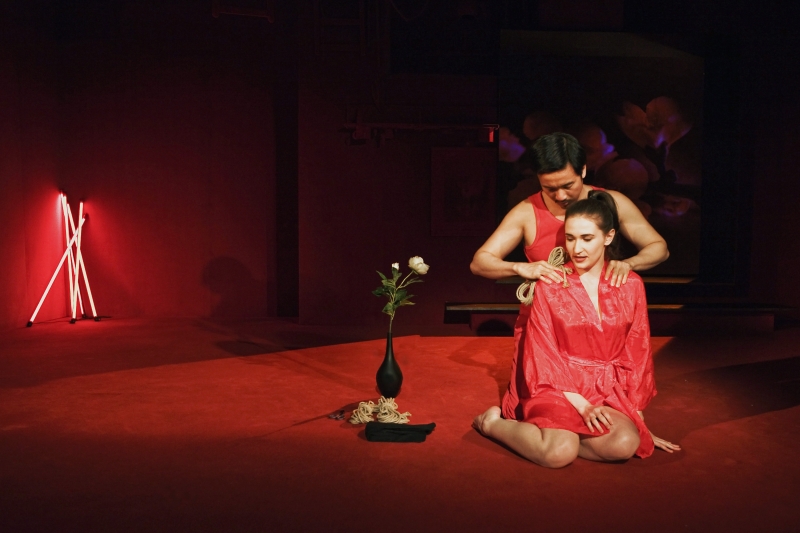
Photo: Fiona Morgan

The Irish are rightly proud of their strong literary and dramatic tradition - wherever you go in Dublin, allusions to Joyce, Beckett, Wilde and Shaw abound. So the prospect of some new Irish writing was an irresistible one for a visiting theatre-lover, as director Tom Creed and playwright Gary Duggan make their Abbey Theatre debuts as part of the Dublin Theatre Festival. Shibari is an odd piece full of dichotomies: its Love Actually-style interlinking of different lives has become conventional, yet its progression is unexpected; while some scenes possess a power and thoughtfulness, others feel rather dead and uninspiring; and whilst some performances entertain and even electrify, one or two would not merit praise in the most ordinary of student productions. With such a mixed reaction, the piece divided my party and left me a little confused - and more than a little frustrated every time a weak point interrupted an intriguing or entertaining element.

Six characters occupy this entwined world of coincidental connections, from widowed Japanese florist Hideo, to down-on-his-luck ordinary guy Liam, to big-name movie star Nick. With the sparse set ornamented with minimal props, it is left to the dialogue and performances to do all the work in establishing setting, scenario and character: by and large, this is successful as the audience quickly find themselves in a bookshop, florist's, nightclub or bedroom without Duggan resorting to trite exposition. Yet a script, of course, needs more than just competency of storytelling, and this one is rather lacking in depth, leaving me questioning how impressive or even interesting it truly is. Some aspects do capture our imagination but others garner little interest; for example, what should be a poignant episode - that of a young widow reflecting on her husband's death as she returns to a long-abandoned dance class - is rather clichéd and wastes the talents of the otherwise convincing Janet Moran (Marie). Ian Lloyd Anderson may not have to stretch himself too far to play up to the Hibernian stereotypes of his character, the rather lazy Liam who is endowed - by his own admission - with a substantial dose of "Irish charm"; yet he should be credited for his natural stage presence and confidence, which emerged particularly in his early wry humour, and in his sombre tête-a-tête with fiery sister Eva (an assured Kate Nic Chonaonaigh). By contrast, Michael Yare's performance as Nick has the opposite effect, in undermining the potential of his character through stilted and self-conscious delivery which jars with the supposed confidence and arrogant ease of his role. The rhythm of his speech is far from the natural realism adopted by the rest of the cast: while others embody their characters and situation without a struggle, Yare appears to be acting in a different production from the rest, under markedly different direction. By the end I was beginning to feel irritated that his role was so key to the web of plotlines, as his performance added little to the show and detracted much from its promise.

At the other end of the scale, Orion Lee is impressively sympathetic and sweetly amusing, yet progressively and ultimately unsettling, as Japanese florist Hideo. A figure of aloof sadness and poignant dedication to his art, the development of Hideo's thread of the story proves the most enrapturing, and Lee's rendering of the role is sensitively understated, and consequently the most powerful in the ensemble. It is here that the motifs of the dialogue come into force: the many references to bonds and ties may not be subtle, but they help to shape a play which is searching in vain for a strong structure and meaning. Shibari certainly leaves the best until last, as the final climactic scene is affecting in its slow, deliberate pace, shocking without crossing the line into sensationalist or gratuitous, and flawlessly played out by Lee and Alicja Ayres (Ioana). The harshness and innate threat of the ropes somehow becomes beautiful in the attention to detail of director and cast. It is an unsettling conclusion, executed with finesse - if the entire show had been of this calibre, Duggan and Creed would be on to a winner.

Yet the overall effect and the play's lingering impression is one of fragmented achievement and part-successes. There are some thoughtful and enjoyable elements here but in attempting to explore what makes this lively city tick, Duggan fails to really get under the skin of the characters he is creating. Combined with a cast who are rather varied in their ability and suitability, and Shibari ends its run at the Abbey Theatre to a soft vote of thanks, rather than a shout of triumph.

Wednesday, 7 November 2012

THEATRE REVIEW: Three Sisters

Young Vic

29 Oct 2012


Three Sisters trailer; courtesy of The Young Vic/Dusthouse

This is Chekhov as you have never seen it before. Raucous, dirty, vodka-fuelled, surprising, coarse, funny, uninhibited, destructive - and magnificent. Benedict Andrews' modern adaptation of the script tears down our expectations whilst breathing new life into a classic tale of love, sisterhood, despair and hope.

Under Johannes Schutz's design, the simple grey stage of the Young Vic is coldly lit and bare, a large mound of earth the only scenery. As characters make their entrances, the full space is utilised, with unusually large areas of empty stage between them: it is fragmented, jarring almost, to see a cast working together fluidly when physically so separate. The titular three sisters are introduced to us, and from her first appearance it is clear who will steal the show: Vanessa Kirby is simply superb as Masha. Her movement around the stage is so instinctive, so fluid, that not the slightest pretence is needed - she is not playing Masha, but has become her, utterly embodying the part in every toss of her head and every drawl. It is her spirit that seems to guide the production, with its irresistible mix of glamour, thrill, heartache and wretchedness. Beside this, Olga (Mariah Gale) risks appearing a little dull and anonymous, but some skilful and balanced direction by Andrews ensures her more understated performance is not overwhelmed. Completing the trio is Gala Gordon as unintentional heart-breaker Irina, whose transformation from sweet youth to hardened bitterness and despair is truly touching and at times difficult to watch in its soul-baring pain.

Although the girls are given some simple period dresses, there is nothing much conventional about this production. As the vodka flows, the expletives rack up and before you know it the cast are dancing on the tables and belting out Smells Like Teen Spirit. It's a brave move by Andrews and it works perfectly. Chekhov and grunge - who would've thought such a bizarre marriage could be so fruitful? The scene is funny, no doubt - and indeed there is much humour across the board here, from the brash, Aussie Natasha (Emily Barclay) to the inebriated Chebutykin (the splendid Michael Feast); from the brow-beaten Andrey (a tracksuit-wearing Danny Kirrane) to the loveable, sensitive Tuzenbach (Sam Troughton). Yet it is also thrilling in its raucous energy and verve, and in its contrast to the beautiful moments of stillness elsewhere in the play in which laughter and pathos are woven together in excruciating rawness. It is also demonstrative of the importance of sound as well as visuals, as peace is repeatedly and jarringly interrupted by singing, shouting, or by the uncomfortably loud bell which cuts through the calm, jangling painfully, in the second half.

There is a wonderful sense of synergy to the piece, as one or two individual performances which alone may be quite ordinary - William Houston's rather smug Vishinin, for example - bounce off others around them and become a seemingly vital element in the ensemble. Fragmentation is certainly a powerful theme as the sisters are gradually abandoned by all, and the slow, deliberate removal of the stage itself, piece-by-piece, is a stroke of brilliance; yet the force of togetherness inherent in the final tableau of Masha, Olga and Irina embodies the powerful bonds of raw humanity in this piece.

This bolshy yet nuanced production packs a real punch, with rare intensity and focus in its wildness. It is a tribute to the show's ability to hold an audience that I could have happily sat through it all without an interval, even on some of the most uncomfortable theatre seats in London. Its breathless energy, delightfully messy stage and wonderful performances, led by Vanessa Kirby, will not be forgotten any time soon - in short, a triumph.

THEATRE REVIEW: Our Country's Good

Out of Joint

Nuffield Theatre, Southampton

16 Oct 2012
(Touring Sept-Nov 2012; St James' Theatre, London Jan-Mar 2013)
               
This latest revival of Timberlake Wertenbaker’s 1988 work conflates the old and the new, the past and the future. Max Stafford-Clark returns to the play he originally directed for the fourth time, but this time it is with an unusually youthful cast; the drama is steeped in history, yet its focus on the art of putting on a play makes it unavoidably and perpetually relevant whenever it is performed; and although death and enslavement pervade the story, somehow there is hope and salvation inherent in all its words and action. These combinations provide the magic which ensures this play remains a compelling tale of struggle, comradeship, and the power of theatre. If that sounds a little clichéd, then maybe it is; but in fact this production, after some rather weak beginnings, reveals a vitality and spark which disperses cliché and triteness and for the most part keeps things both rousing and intense.

Our Country's Good trailer - courtesy of Out of Joint/Jonny Walton/kaptur.co.uk

For the first twenty minutes or so, the show hovers on the brink of disappointment. The opening scene, with its convict ship tableau, may have appeared more avant garde in Stafford-Clark's original conception of the show, but here feels a little staid and predictable - certainly not the most gripping introduction ever performed. Yet to give the show credit, it soon came into its own as the cast sharpened their act up and got into their stride: indeed, more than a stride, rather a quickening run, as the production gathered pace and dipped and dived from hilarity to despair. The relatively young cast breathe fresh life into the work, bringing energy and vigour as well as deep pathos as, in the bold and heady Antipodean climate, the fragility of life emerges. Epitomising this is the wonderful, scene-stealing Kathryn O'Reilly as fiery Liz Morden, who brought shouts of slighted laughter yet also moments of painful, stomach-kicking silence in her dogged refusal to defend herself. O'Reilly is ably supported by Laura Dos Santos as a charming yet surprisingly steely Mary Brenham and Helen Bradbury in a forceful yet nuanced performance as Dabby Bryant. Similarly, Lisa Kerr as Duckling demonstrated Wertenbaker's talents in weaving subtle and interesting roles as she exploited all facets of the character: stroppy, coarse, empty, heartbroken and desperate, Duckling's is sometimes a tricky progression to negotiate believably, and Kerr did an impressive job of coping with the challenge, ably supported by her ageing lover Harry (Ian Redford).

Not everything lives up to this standard, with some scenes falling back into the suggestions of dragging stasis hinted at in the opening. With the stage heavily populated in the officers' meeting, the cast struggles to keep up the spark of interest and dynamism which is so powerfully present elsewhere: the episode feels long and drawn out, with little tension to sustain it. Dominic Thorburn's Ralph teeters on the edge of falling into a similar pattern, as his early appearances gave the impression of detachment and a lack of identification with the role; yet Thorburn gradually channels this awkwardness into a subtle depiction of the naive young officer, and, by the climactic ending, flourishes in the part. Elsewhere, Wertenbaker's titling of her scenes has felt like a problematic device for directors, and Stafford-Clark's decision to keep some, but not all, in the spoken script was not convincingly thought out, with the effect being a little stilted, rather than adding anything memorable to the performance.

These moments of uncertainty are an unfortunate muddying of the waters in a production that is otherwise triumphant in its humanity and emotional core. Just like the convicts and officers themselves, there is a sense that despite moments of difficulty, something sincere cannot help but shine through.